Fluorine Protons

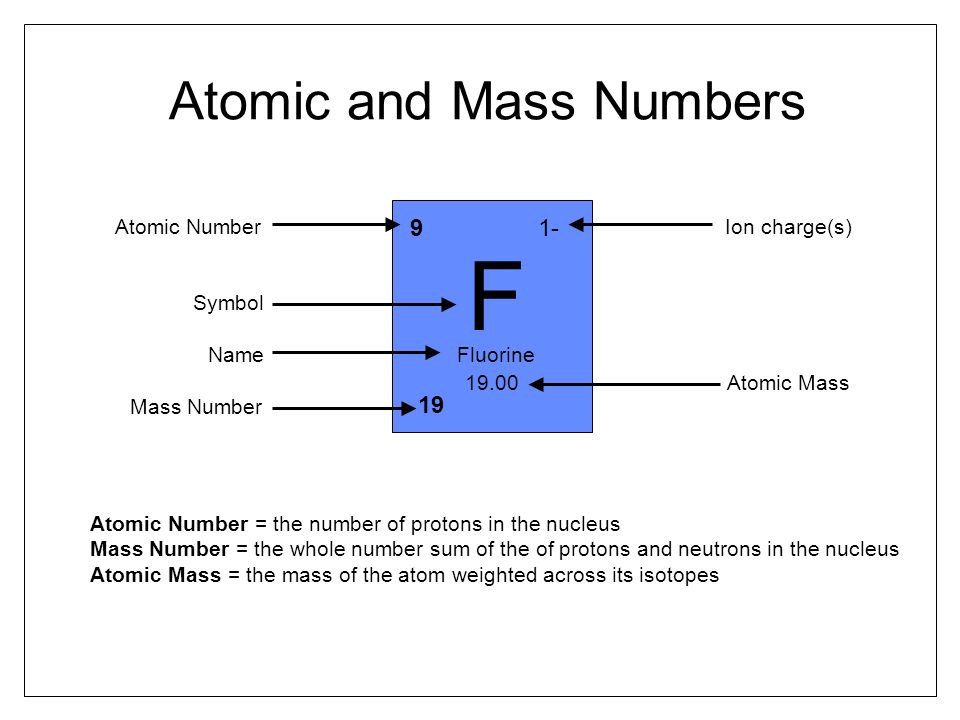
Fluorine also has notable nuclear properties. Natural fluorine has only one isotope, fluorine-19, with nine protons and ten neutrons. Often, elements have several stable isotopes. But fluorine only has one. Even more importantly, that single isotope of fluorine has a very low neutron absorption cross section. Play this game to review Atoms & Molecules. Tin (Sn), is a soft white metal. It has a low melting point compared with other metals. Tin is widely used as a coating for cans of food. Fluorine was produced at the positive electrode. (3) Henri Moissan received the 1906 Nobel Prize in Chemistry for his achievement. Interesting Facts about Fluorine. Henri Moissan, who first isolated fluorine, also produced the world’s first artificial diamonds by applying huge pressures to charcoal. Fluorine is the most chemically reactive.

Fluorine Protons Neutrons Electrons Valence Electrons
Click to see full answer.
Likewise, people ask, does fluorine gain or lose electrons?
It can lose one of its electrons, making it an ion. It now has more positive protons than electrons so it has an overall positive charge. A fluorine atom will tend to gain, rather than lose, an electron. By gaining a negative electron, it has an overall negative charge.
what happens when an atom gains an electron? However, if something happens to make an atom lose or gain an electron then the atom will no longer be neutral. An atom that gains or loses an electron becomes an ion. If it gains a negative electron, it becomes a negative ion. If it loses an electron it becomes a positive ion (see page 10 for more on ions).
Correspondingly, how many electrons does fluorine gain or lose?
Example 1: A fluorine atom can get a full valence shell by either gaining one more electron, or by losing seven electrons. The former requires the transfer of less electrons, so the fluorine atom will try to gain one electron first. Therefore, F− ions are more common than F7+ ions.
What happens when fluorine atoms react?
Fluorine is in Group 7. It has seven electrons in its outer shell. It gains an electron from another atom in reactions, forming a fluoride ion, F-. A fluoride ion has the same electronic structure as a neon atom (Ne).
Fluorine Protons Neutrons Electrons
| One lithium (Li) atom can combine with one fluorine (F) atom. Together, they make the formula LiF. Fluorine has seven electrons of it's own. Lithium gives up its one electron to make both atoms happy. So the fluorine atom has eight electrons, and a filled outer shell. | ||
| Two fluorine (F) atoms can also bond with one beryllium (Be) atom, making the formula BeF2. Beryllium gives up one of it's electrons to each of the fluorine atoms. The result give each of the fluorines eight electrons, making their shells full. | ||
| Fluorine (F) can also bond with aluminum (Al). Aluminum has three extra electrons and will easily let the fluorine atoms use them. Because aluminum has three, that means three fluorines can bond. The make the formula AlF3, also known as aluminum trifluoride. Each of the fluorine atoms gets an electron to fill their shell, and the aluminum loses three, giving it a filled shell too (remember, aluminum has three extra electrons). The name trifluoride means three fluorine atoms are involved. | ||